Saturday, April 11, 2020

Sangeeta Deepam | The light of music


Sangeeta Deepam| The light of music

5th April, 2020

In our global fight against the pandemic, expressing solidarity and collective spirit through music. Didn't expect this to feel quite so real! Thanks to over 50 participants who joined us from across the globe to encourage this cross-border experiment where musicians in the US and India collaborated over zoom. We will work on the technical audio-visual aspects to improve upon the experience. May everyone experience joy, May all be free of illness May everybody see goodness, May no one have to suffer ॐOm, peace, peace, peace Artists in the US: Keerthi Madapusi Pera: Carnatic Vocal Srinivas Reddy & Nitin Mitta: Hindustani Instrumental Artists in India: Rajiv and Soham Bhatt: Tabla duet

https://www.youtube.com/watch?v=LevctiiVOos
#StayAtHome #WithMe #music4society #MusicFromHome


Kaida of Social distancing 

22nd March, 2020

As we continue our efforts to curb the COVID-19 pandemic through social distancing, this is an experiment in remote collaboration through music. The power of music and technology to connect, collaborate and spread happiness! Four guru-bhais (students of Pandit Nakul Mishra) recorded their pieces of the famous Beneras gharana Kaida (Dhiga Dhina Tirakit Dhina) at their time and place, several miles apart. The underlying connection was teentaal (16-beats), 110 bpm tempo, Scale C#, and nagma in Charukeshi. Music4Society hopes this concept spreads and such music collaborations increase across borders.

https://youtu.be/rYkkZk88SbU

Artists: Rajiv, Soham, Keyur, Ajay

Friday, March 15, 2019

Few glimpses and demonstrations of the rich Tabla repertoire!


Theka: Meditation through Tabla!


Theka is probably the most essential but highly underrated aspect of Tabla.
Theka is like a sutra, a thread, that comprises of minimal yet essential Tabla syllabi which provide form, beauty and character to a rhythmic cycle. From a musical standpoint, a simple yet appropriately embellished theka serves multifold purposes, i.e. keeping time, fostering creativity of the accompanying artists, inspiring them to bring out their best, and enhancing overall aesthetic beauty of the music.
From a spiritual standpoint, a theka can be extremely meditative. Theka, when rendered repetitively at a constant (slow to medium) tempo on a well-tuned Tabla, can become an effective tool to control thought-waves (vritti), regulate breathing (prayanam), and calm the mind (chitta)- leading to a meditative state.
Here is a short demo of theka in Teentaal (16 beats), the most popular rhythmic cycle in Hindustani classical music. (Headphones recommended to hear the base (bayan))
It is incumbent on Tabla gurus/teachers to ensure that students understand and appreciate the importance of Theka, and not rush into complex and fast-paced compositions.


Rela
A short "Rela" in vilambit (slow) Teentaal (16-beats). Rela generally comprises of phrases such as tirakita, dhinagina, dhir dhir etc, which, when played at a fast speed, give a feeling of uninterrupted flow. This rela uses the phrase 'dhinagina'. Rela expands like a "Kaida", but is generally shorter than a Kaida, and ends with a tihai.


Kaida - Poetry in Tabla

"Kaida" literally means "rule". It comprises of a main theme which is a set of aesthetically compatible phrases symmetrically divided into two segments, both segments ending with rhyming phrases such as "Dhati Dhage Tina Kina" and "Dhati Dhage Dhina Gina". The phrases in the main theme can be mathematically permutated and combined to create several poetic variations (or paltas). A Kaida challenges the Tabla player's creativity, since the rule is that the variations have to be based on the phrases in the main theme only. This is a classic example of "creativity within limitation"! The quality of variations depends on the Tabla player's creativity, gharana, and tutelage.
Here's a Kaida in Teentaal (16 beats) to give a glimpse of this wonderful poetic composition in the Tabla repertoire.


Peshkar

Peshkar is one of the most beautiful and creative aspects in Tabla repertoire. Peshkar, the Urdu word literally means, "to present", or "one who presents". A Tabla solo recital in Delhi, Farukhabad, Lucknow, Ajarada and Punjab gharana typically opens with a Peshkar. Just like an Alaap in vocal music, the Peshkar explores the fundamental bols and phrases of Tabla, expands them mathematically and aesthetically and ends with a Tihai or lends into a kaida.
While a Peshkar can typically be much longer, here is a short impromptu Peshkar set to 10 beats (Jhaptaal).


Monday, November 11, 2013

An article in NY Times which reinforces the benefits of music

Interesting article on Music in the New York Times:

Condoleezza Rice trained to be a concert pianist. Alan Greenspan, former chairman of the Federal Reserve, was a professional clarinet and saxophone player. The hedge fund billionaire Bruce Kovner is a pianist who took classes at Juilliard.

Multiple studies link music study to academic achievement. But what is it about serious music training that seems to correlate with outsize success in other fields? Check this link:


http://www.nytimes.com/2013/10/13/opinion/sunday/is-music-the-key-to-success.html

Saturday, August 03, 2013

Promoting Music at IIT and Schools

Lecture-Demonstration at the Foundation Program at IIT - August 2013

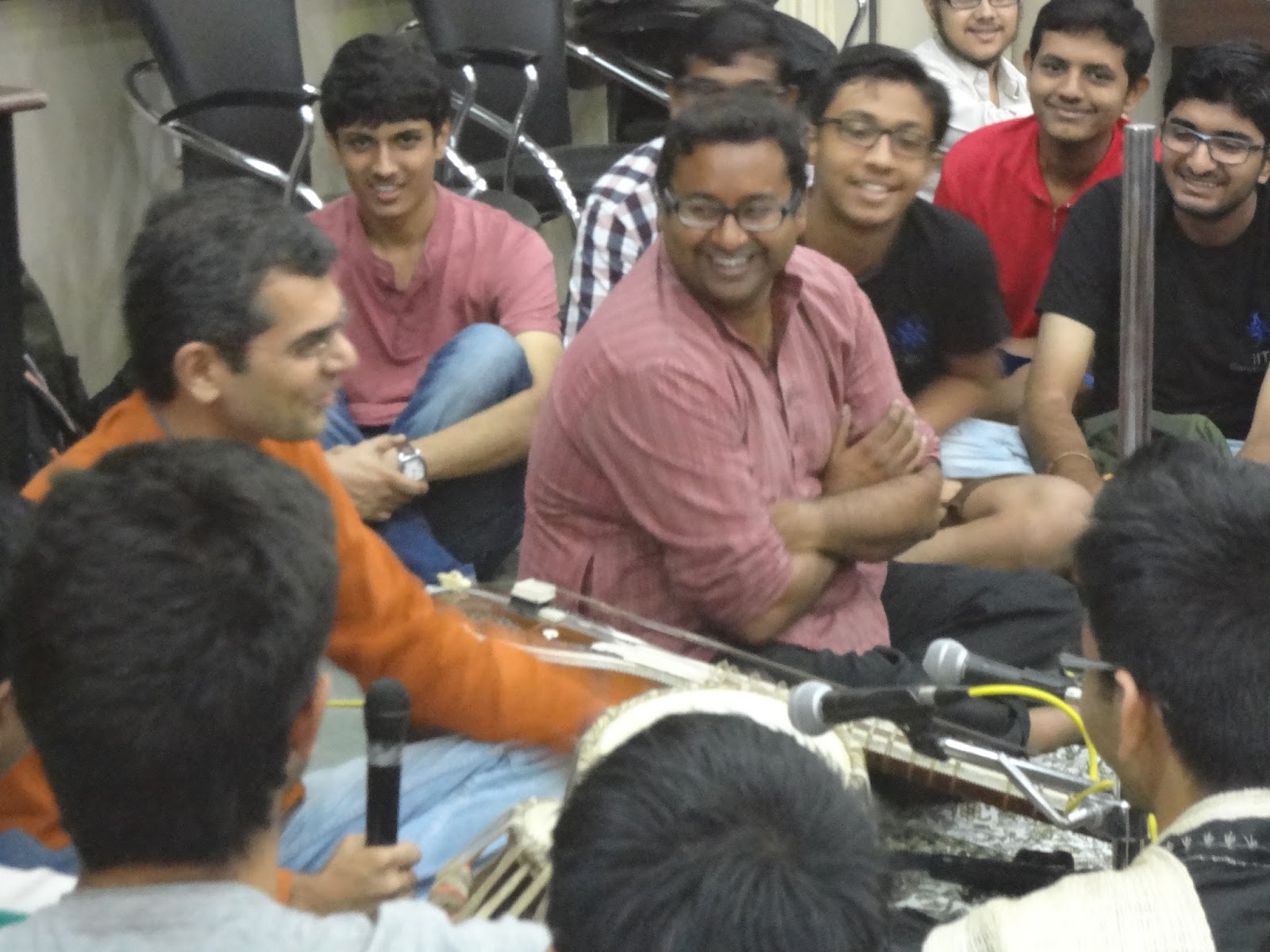
An interesting interaction on Tabla with the freshers at IIT-Gandhinagar. Was glad to see the 'right' side of our future engineers! I commend IIT for including this session in their Freshers Induction program. Students had fun learning the basics of Teentaal and some of the compositions set to Teentaal. The lec-demo included discussions around evolution of Tabla, various gharanas (schools) of Tabla, Art and Science of Tabla playing, demo of compositions such as Uthan, Peshkar, Kaidas, Tukdas, Chakradaars, Gats, and Relas.The Tabla lec-demo was followed by a Sitar-Tabla duet with Srini.


Tabla demo at IIT - April 2013


Juganbandhi (Duet)

 Tabla and Piano Demonstration

Tuesday, January 15, 2013

Appreciating Indian Music and Tabla: Session for Children and Parents

Indian Music comprises of various genres such as Classical, Semi-classical, folk, bhajans, film, popular, rock etc. While the popular, rock and other modern forms of music have been greatly influenced by Western music, the traditional Indian forms of music – classical, folk, bhajans, semi-classical (thumris, tappa, ghazals) etc continue to demonstrate the uniqueness and originality of Indian music and are today appreciated by musicians and audiences across the globe. Indian classical music, which can be broadly divided into Hindustani and Carnatic music, has a rich tradition dating back to more than 4000-5000 years.


Research has shown that music, particularly classical music, has a positive impact on the holistic development of a child. Children who start learning music at an early age tend to excel in academic, are generally more intelligent, more confident, and less disruptive.

Session highlights:

Objective: Sensitization to some of the facets and benefits of Indian Classical Music, including Tabla

o It will highlight the benefits of music on a child’s development as well as how music can help in developing a holistic personality.

o Children would be made aware of different forms of music, musical instruments and musicians

o There would be a short Tabla demonstration explaining the history, anatomy, language of Tabla, various Gharanas, role of Tabla in today’s music, and a typical Tabla solo progression.   Session conductors: Rajiv Bhatt and Soham Bhatt

Wednesday, September 05, 2012

Tabla lecture-demonstration at Nirma Institute of Management Studies (Aug 2012)

It was an enjoyable Tabla lecture-demo. Thanks to the Fiesta club at NIMS for inviting and organizing this event. Am impressed by the co-ordination and management skills of these 1st and 2nd year MBA students at NIMS who manage the Fiesta club. It was also fun to jam up with two guitarist amongst the management students.

Music is a great way to connect!


Thursday, August 16, 2012

Tabla Workshop for International Students

August 2012

It was a pleasure to conduct a half-day Tabla workshop for a diverse mix of international students at the PDPU, Gandhinagar. My son, Soham (8 years) and my guru's son, Dhyanesh (12 years) were my able assistants. Indeed, music transcends cultural and geographical barriers. Sound and Rhythm are universal, and Tabla is one of the prominent means of presenting sound and rhythm in an interesting and universally-appealing manner.

Tuesday, July 12, 2011

Lecture-demonstration at School of Interior Design, CEPT, Ahmedabad

A lecture-demonstration to a group of German and Indian students at SID, Ahmedabad.

Explained and demonstrated some of the nuances of differents gharanas of Tabla, and different compositions (peshkar, kaidas, tukdas, paran, gat, rela etc).


Friday, February 11, 2011

Tabla solo on Doordarshan (DD-Girnar) - An Experience!

The journey of Tabla playing leads to interesting and memorable experiences, one of which has been a Television performance on Doordarshan channel (DD-11, popularly known as DD-Girnar). This 14 min (approx) Tabla solo was telecast on 9th February 2011, under the youth programe of the channel. I remembered the DD studio from my recordings done about two decades ago.

This would remain a memorable experience! Vaibhav rendered the lehra in raag Charukeshi on the Harmonium.


Wednesday, December 15, 2010

Management and Music

Can Management be learnt through Music? How can a better understanding and appreciation of different genre of music help one to become a better manager? What are the analogies between management and music? Can the future managers consider music as a career option?

These were some of the questions which I tried to address during a session on 'Management and Music' with students of a management institute in Ahmedabad, India.


This interactive session drew parallels between Management and Music, by illustrating managerial attributes expressed by musicians across different genre of music. Students were exposed to short musical pieces from different genre of music to identify the managerial attributes within those musical pieces. The discussions were blended by various research findings which show that music can help in enhancing various critical abilities which are desirable in a good manager. The session concluded with a short Tabla demonstration.


Monday, November 29, 2010

Exploring Tabla - An interactive demo at Prayaas (IIM-A)

The children at Prayaas (http://www.facebook.com/#!/pages/Prayaas/228852570021), an IIM-Ahmedabad initiative, were quite excited to have a first-hand exposure to Tabla. They could listen, touch and also play the Tabla! It was fascinating to see their keen interest in exploring this instrument, which today is one of the foremost percussion instrument in the world.


Soham giving a demonstration
Children at Prayaas exploring Tabla

Sunday, October 17, 2010

Indian Music and Tabla Lecture-Demonstration at SGVP, Gurukul, Ahmedabad

In order to promote Indian Music and Tabla amongst youth and kids, I have intiated voluntary lecture-demos at educational institutes.

We were indeed privileged to have been invited at SGVP, Gurukul, Ahmedabad to give a lecture-demonstration on Indian Music and Tabla. This gave us an opportunity to interact with an enlightened auidience, and to share several research findings on music which show that music has a positive impact on the holistic development of our brain, and on the development of a child.