Thursday, September 24, 2009
Origin of Tabla


Thursday, October 09, 2008
Tabla as an Accompanying and Solo Instrument
Tabla: Role in Accompaniment
Tabla is widely used as an accompanying instrument in vocal, dance, and instrumental music. The key role of a Tabla player in an accompaniment is to keep time for the main artist and to enhance the aesthetic value of the raag (melody). The challenge for him is to show his virtuosity while being restraint. He should follow, and not overshadow, the main artist. During the performance, the main artist intermittently gives opportunities to the tabla player to demonstrate his virtuosity. The challenging aspect for the tabla player is to play compositions or improvisations that blend with the mood & raasa of the raga and the rhythmic patterns played by the main artist.
Out of the various facets of accompaniment viz. Instrumental, Classical Vocal, Semi-Classical Vocal, Dance etc, the fundamental progression of an instrumental accompaniment is shown here:

In an instrumental accompaniment, Tabla enters the recital in the ‘Gat’ phase after the Aalap, Jod & Jhala phases. The ‘Gat’ phase comprises of an alternation between the main theme and melodic variations.The Tabla player gets a chance to show his virtuosity when the main theme is being played. However, when the main artist is playing melodic variations, the Tabla player should constrain his playing to the basic Theka or its Prakars and clearly bring out the ‘Sam’ and ‘Khali’ to enable the main artist to judge where he is within the context of the Taal.
Tabla Solo Performance
A Solo rendition provides the Tabla player an opportunity to demonstrate his virtuosity and mastery over the various facets of Tabla playing such as different gharanas,rhythm cycles, tempos, traditional compositions, improvisations etc. Solo performances are typically accompanied by a repeating background melody called 'Lehra'. Lehra is fit to a rhythmic cycle. Besides providing a background melody, the Lehara essentially keeps time for the soloist and provides a baseline that guides the performance of the soloist within the framework of the Taal. Typically, Lehra is played on Harmonium or Saarangi.
For example: a Tabla solo set in Teentaal would be accompanied by a Lehara set to 16 beat cycle.
The progression and format of a Tabla solo largely depends upon the gharana, artistry & mood of the Tabla player and also on the quality of audience. For instance, two solo performances of an artist set to Teentaal could greatly vary in terms of progression and format, depending on the variables mentioned above.
However, a typical progression of a Tabla Solo could be depicted as under:
Uthan >Peshkar > Kaida > Gat > Tukada > Chakradar > Rela
Sunday, March 09, 2008
Saturday, March 08, 2008

Monday, February 25, 2008
Friday, June 22, 2007
Dinner with the Flute maestro!

In the picture above, Hariji can be seen in a casual attire and a very relaxed mood.
The dinner in progress...

Sunday, May 06, 2007
Tabla with Santoor

Santoor, typically a North Indian folk instrument, derives its name from 'san' - meaning hundred, and 'toor' - meaning strings. It is a 100-stringed instrument. Pandit Shiv Kumar Sharma brought this folk instrument into the forefront of Indian classical music. An excellent treatise on Santoor can be read at http://www.santoor.com/.
Soham trying to accompany Shri Bharatbhai...


Wednesday, April 18, 2007
Compositions in Tabla
Cyclic:
Cyclic compositions roll-on with a sense of balance and repose. They establish the fundamental rhythmic pattern upon which the player builds up his performance and thus provide a sort of a musical framework for tabla solos and accompaniments.
E.g: Theka, Kaida, Rela, Peshkar
Cadential (Non-Cyclic):
Cadential compositions on the other hand possess a ‘tension-resolve’ mechanism. In other words, they create a sense of tension that resolves at a point, usually the SAM. They provide energy & momentum to the performance.
E.g: Mukhada, Tukda, Tihai, Chakradar, Paran, Gat
The alteration between cyclic and cadential compositions is the hallmark of tabla solos and accompaniments.
This alteration between cyclic and cadential compositions can be visualized as:
 Here I explore two most commonly played forms each of cyclic and cadential compositions i.e. Theka and Kaida under Cyclic and Tihai and Tukada under Cadential.
Theka (Cyclic)
Theka, literally meaning ‘support’, is synonymous to the basic form of taal. It is extensively played in accompaniments with vocalists, instrumentalists or dancers to give the main artist a sense of cyclic rhythm, timing and beats within which he can perform. Variations/improvisations of a Theka are called ‘Prakars’. Theka is the most pure form of measure of time in Tabla. A beautifully played Theka is a treat to listen. During an accompaniment, even small but rightly timed improvisations in Theka add immense aesthetics to the music.
Kaida (Cyclic):
Structure:
Theka > Kaida > Variations > Tihai > Theka
Kaida is one of the most challenging aspect of Tabla playing. Kaida essentially means a ‘Rule’. The main theme of a Kaida comprises of a set of bols. The Tabla player is expected to use only the bols set out in the main theme and create improvised variations (‘Paltas’ or ’Vistars’) out of them. A continuity is generated in kaida where each phrase building the Palta is a variant of a preceding phrase.The virtuosity of a Tabla player is demonstrated by the number and type of Paltas played. The formation of Paltas is both an art and a science. Theoretically, innumerable Paltas could be created using different permutations and combinations of the bols in the main theme of the Kaida. However, the selection of logical variations is an art. Creating paltas is thus a creative challenge & depends largely on the tabla player’s virtuosity.
The kaida and the variations follow a ‘bharali-khali’ (‘Full-Empty’) pattern. The first part of the kaida/variation is call the ‘bharali’ and the second part, the ‘khali’. Bharali normally begins with baiya-predominant bols such as ‘Dha’, ‘Dhi’ or ‘Ge’. Khali normally begins with daya-predominant bol such as ‘Ta’ or ‘Ti’. However, some kaidas have khali beginning with flat bols such as ‘Ki’ or ‘Ke’ played on baiya.
Tihai (Cadential):
A Tihai (=’Three Times’) is a composition comprising of a phrase (pala) that is played three times. It may be set to one or more cycles of a Taal. A tihai normally ends on the first beat ( or Sam) of the rhythmic cycle. However, some tihai’s end before or after the Sam and are termed anagat tihai and atit tihai respectively.
The phrases of a tihai can be linked in one of two ways. One way is to use a time interval (pause) between the three palas (phrases). This is called a dumdar tihai. The second approach has no pause between phrases. This is referred to as bedum.
Tihais are one of the most frequently played rhythmic patterns in tabla and are an integral part of most forms of rhythmic compositions (i.e Kaida, Tukda, Rela etc). They have an equally important and irreplaceable role in all forms of Indian Classical music (i.e vocal, instrumental and dance).
Tukada (Cadential):
A Tukada (= ‘a piece’) is a short composition, generally comprising of heavy bols such as DhiTa’, Dhet, DhaGe, TeTa’ etc. As it is played with weighty strokes, Tukada is conspicuous by its absence in extremely light and folk styles of tabla playing. However, Tukadas are extensively played in solos and accompaniments with instruments and dance. Tukada could be plain or tihaidar/chakradar (ending with a tihai or having three palas).
Wednesday, January 10, 2007

Monday, January 08, 2007
Understanding the Tabla
This blog - Understanding the Tabla - attempts to initiate and, to some extent, explore the nuances of Tabla in a very lucid manner. It would help to put in perspective the theoretical, conceptual and practical aspects of the art and science of Tabla playing and some of the possibilities of incorporating Tabla into fusion music. It draws from the hands-on experiences of the author. Comments from pratictioners and music/tabla enthusiasts are sought.
IMPORTANT NOTE FOR STUDENTS OF TABLA
This blog in no way attempts to substitute or undermine the importance of tutelage from a Guru (teacher). Advanced knowledge on Tabla playing should be obtained from a Guru. To successfully navigate through the arduous roads of Tabla, the guidance and blessings of a Guru is paramount. In the picture, students are being blessed by teachings from Late Ustad Allah Rakha Khan - The Legendary Tabla Maestro, at my Guru Pandit Shri Divyang Vakil's residence.

A Guru, an exponent in the art & science of Tabla playing, builds up a strong technical and theoretical foundation in the Shishya (student), satisfies his curiosities, clarifies his doubts and makes the student capable of manifesting his creativity, thus making him capable to confidently take on the journey of Tabla. To make the most of the Guru-Shishya relationship, the Shishya should complement his Guru’s teachings with devoted Riyas (practice). The Riyas would largely involve playing the tabla, recitation of the compositions, contemplation, listening & observing other artists playing. The Guru is able to figure out the strengths and weakness of his Shishya and tailor the Riyas sessions to address those weaknesses.
Tabla – The Instrument
Tabla is the principal North Indian percussion instrument. It is extensively used as an accompaniment instrument for time-keeping and embellishment in various forms of Indian music viz. classical, semi-classical, folk, dance etc. Besides, over the years, it has also attained a coveted & revered status as a ‘solo’ instrument.
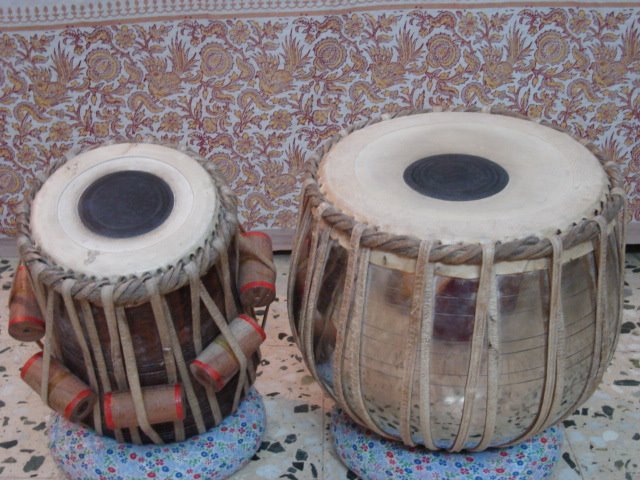
Tabla comprises of a pair of tuned drums to be played with both the hands. The pair of drums consists of a high-pitched, right hand drum, the dahina (also called dayan or tabla), and a low-pitched, left hand drum, the bayan. However, it is not a rule-of-thumb that the dahina must be played with the right hand and the bayan with the left. It depends on the tabla players basic instincts. There are quiet a few prominent tabla players who play the dahina with their left hand and the bayan with their right hand.
The dahina is responsible for many of the resonant & high-frequency sounds (or bols). It is tuned to a specific musical note. The tuning range of the dahina depends on its diameter. The tuning pitch is inversely related to the diameter, which may range from under 5 inches to over 6 inches (smaller the diameter, higher the pitch). Tuning the dahina is done by a hammer and is an art in itself which one learns by experience. A properly tuned tabla is a must for any accompaniment/solo rendition. The dahina is almost always made of wood (primarily saag wood or seasam wood)
The bayan provides the bass and is characterized by its swooping bass sounds that provide colorful embellishment. The body of the bayan is commonly made of brass with a nickel or chrome plate. Iron, aluminum, copper, clay or steel could also be used for the body of the bayan.
The combination of the two drums results into a vast repertoire of bol combinations and permutations.
Anatomy of Tabla
The picutre below identifies various parts of Tabla.
1) Pudi (the playing area)
2) Sayahi (the black area on the pudi)
3) Kinar/Chati (Rim)
4) Maidan (‘Ground’, area of the paudi excluding the Kinar and sayahi)
5) Vaghar/tasma (leather lace)
6) Gatta (wooden dowels to control the tension/pitch)

Evolution of Styles of Tabla Playing ("Gharanas")
Though percussion instruments similar to Tabla have been prevalent in India for thousands of years, the Tabla as we see today, has its roots in the royal courts of Delhi in the 17th and 18th centuries. Different styles/schools of tabla playing evolved over time and were named after the geography of their origin. They are known as ‘Gharanas’. The principle Gharanas are: Delhi, Ajrara, Farrukhabad, Lucknow, Benares, and Punjab. Although each of the gharanas has a distinct repertoire of compositions and musical knowledge, there are two major playing styles: Dilli and Purbi. The Dilli style derives its name from Delhi. It is characterized by a strong emphasis on rim strokes and use of the middle finger. The Purbi style derives its name from the Hindi word "purab". Purab means "Eastern" and reflects the fact that this style was popular in Lucknow, Benares, and other eastern parts of the country. The Purbi style is characterized by open hand strokes and a strong emphasis on material from pakhawaj (an ancient barrel shaped drum from which tabla was derived).
The origin of Gharanas can be largely attributed to geographic isolation due to lack of communication and transportation facilities in ancient times. Hence, in ancient times, exponents of a Gharana used to play compositions of their Gharana only and to some extent despised other Gharanas. However, in recent times (starting mid-twentieth century), with better communication and transportation facilities and an open approach, new generation tabla players (e.g: Ustad Zakir Hussain, Pandit Kumar Bose, Pandit Swapan Chaudhri, Pandit Anindo Chatterjee etc.) have become more versatile and freely use compositions from different Gharanas in their playing repertoire. Thus, the strict boundaries between Gharanas are getting blurred and there is an increasing trend towards convergence of various Gharanas