Tabla playing is an extremely intricate art and science. Although there is yet no absolute clarity on the origin of Tabla, the fact remains that today Tabla has gained a prominent position in the repository of Indian Classical & fusion music, both as an accompaniment and a solo instrument. Tabla has an unfathomable and rich repertoire of rhythmic compositions which when played by an exponent (an Ustad or a Pandit), keeps the listeners spellbound. Gaining mastery in the art and science of Tabla requires an immensely committed, sincere and enduring effort from a student. Even great maestros of Tabla consider themselves lifetime-students of Tabla, thus bringing into perspective the vastness and potential of this enchanting instrument. The more one travels down the road of Tabla, the more he/she gets involved and greater becomes his urge to travel further. Such is the captivation of the fascinating North Indian percussion instrument – The Tabla!
This blog -
Understanding the Tabla - attempts to initiate and, to some extent, explore the nuances of Tabla in a very lucid manner. It would help to put in perspective the theoretical, conceptual and practical aspects of the art and science of Tabla playing and some of the possibilities of incorporating Tabla into fusion music. It draws from the hands-on experiences of the author. Comments from pratictioners and music/tabla enthusiasts are sought.
IMPORTANT NOTE FOR STUDENTS OF TABLA
This blog in no way attempts to substitute or undermine the importance of tutelage from a
Guru (teacher). Advanced knowledge on Tabla playing should be obtained from a Guru. To successfully navigate through the arduous roads of Tabla, the guidance and blessings of a Guru is paramount. In the picture, students are being blessed by teachings from Late Ustad Allah Rakha Khan - The Legendary Tabla Maestro, at my Guru Pandit Shri Divyang Vakil's residence.
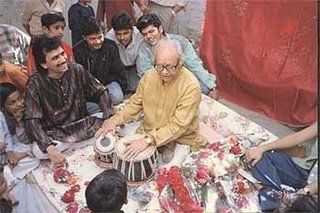
A Guru, an exponent in the art & science of Tabla playing, builds up a strong technical and theoretical foundation in the Shishya (student), satisfies his curiosities, clarifies his doubts and makes the student capable of manifesting his creativity, thus making him capable to confidently take on the journey of Tabla. To make the most of the Guru-Shishya relationship, the Shishya should complement his Guru’s teachings with devoted Riyas (practice). The Riyas would largely involve playing the tabla, recitation of the compositions, contemplation, listening & observing other artists playing. The Guru is able to figure out the strengths and weakness of his Shishya and tailor the Riyas sessions to address those weaknesses.
Tabla – The Instrument
Tabla is the principal North Indian percussion instrument. It is extensively used as an accompaniment instrument for time-keeping and embellishment in various forms of Indian music viz. classical, semi-classical, folk, dance etc. Besides, over the years, it has also attained a coveted & revered status as a ‘solo’ instrument.
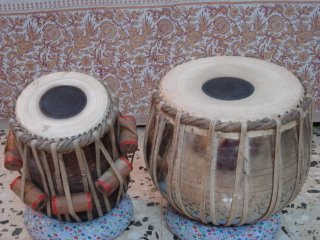
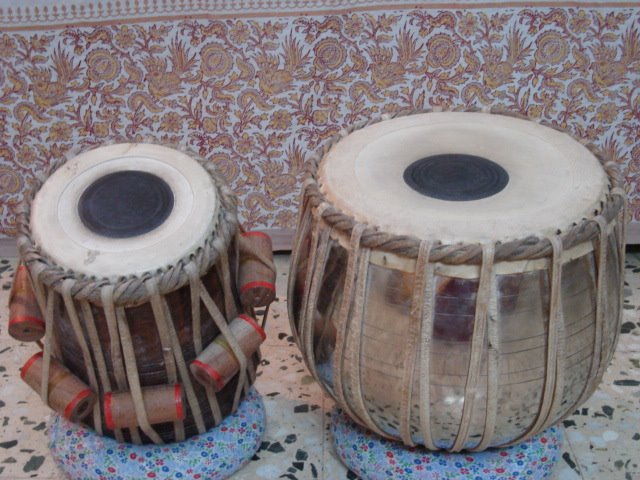
Tabla comprises of a pair of tuned drums to be played with both the hands. The pair of drums consists of a high-pitched, right hand drum, the dahina (also called dayan or tabla), and a low-pitched, left hand drum, the bayan. However, it is not a rule-of-thumb that the dahina must be played with the right hand and the bayan with the left. It depends on the tabla players basic instincts. There are quiet a few prominent tabla players who play the dahina with their left hand and the bayan with their right hand.
The dahina is responsible for many of the resonant & high-frequency sounds (or bols). It is tuned to a specific musical note. The tuning range of the dahina depends on its diameter. The tuning pitch is inversely related to the diameter, which may range from under 5 inches to over 6 inches (smaller the diameter, higher the pitch). Tuning the dahina is done by a hammer and is an art in itself which one learns by experience. A properly tuned tabla is a must for any accompaniment/solo rendition. The dahina is almost always made of wood (primarily saag wood or seasam wood)
The bayan provides the bass and is characterized by its swooping bass sounds that provide colorful embellishment. The body of the bayan is commonly made of brass with a nickel or chrome plate. Iron, aluminum, copper, clay or steel could also be used for the body of the bayan.
The combination of the two drums results into a vast repertoire of bol combinations and permutations.
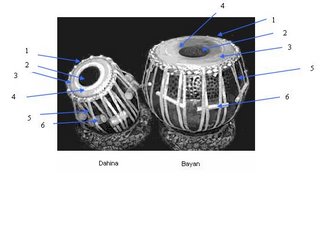
Anatomy of Tabla
The picutre below identifies various parts of Tabla.
1) Pudi (the playing area)
2) Sayahi (the black area on the pudi)
3) Kinar/Chati (Rim)
4) Maidan (‘Ground’, area of the paudi excluding the Kinar and sayahi)
5) Vaghar/tasma (leather lace)
6) Gatta (wooden dowels to control the tension/pitch)
 Evolution of Styles of Tabla Playing ("Gharanas")
Though percussion instruments similar to Tabla have been prevalent in India for thousands of years, the Tabla as we see today, has its roots in the royal courts of Delhi in the 17th and 18th centuries. Different styles/schools of tabla playing evolved over time and were named after the geography of their origin. They are known as ‘Gharanas’. The principle Gharanas are: Delhi, Ajrara, Farrukhabad, Lucknow, Benares, and Punjab. Although each of the gharanas has a distinct repertoire of compositions and musical knowledge, there are two major playing styles: Dilli and Purbi. The Dilli style derives its name from Delhi. It is characterized by a strong emphasis on rim strokes and use of the middle finger. The Purbi style derives its name from the Hindi word "purab". Purab means "Eastern" and reflects the fact that this style was popular in Lucknow, Benares, and other eastern parts of the country. The Purbi style is characterized by open hand strokes and a strong emphasis on material from pakhawaj (an ancient barrel shaped drum from which tabla was derived).
The origin of Gharanas can be largely attributed to geographic isolation due to lack of communication and transportation facilities in ancient times. Hence, in ancient times, exponents of a Gharana used to play compositions of their Gharana only and to some extent despised other Gharanas. However, in recent times (starting mid-twentieth century), with better communication and transportation facilities and an open approach, new generation tabla players (e.g: Ustad Zakir Hussain, Pandit Kumar Bose, Pandit Swapan Chaudhri, Pandit Anindo Chatterjee etc.) have become more versatile and freely use compositions from different Gharanas in their playing repertoire. Thus, the strict boundaries between Gharanas are getting blurred and there is an increasing trend towards convergence of various Gharanas